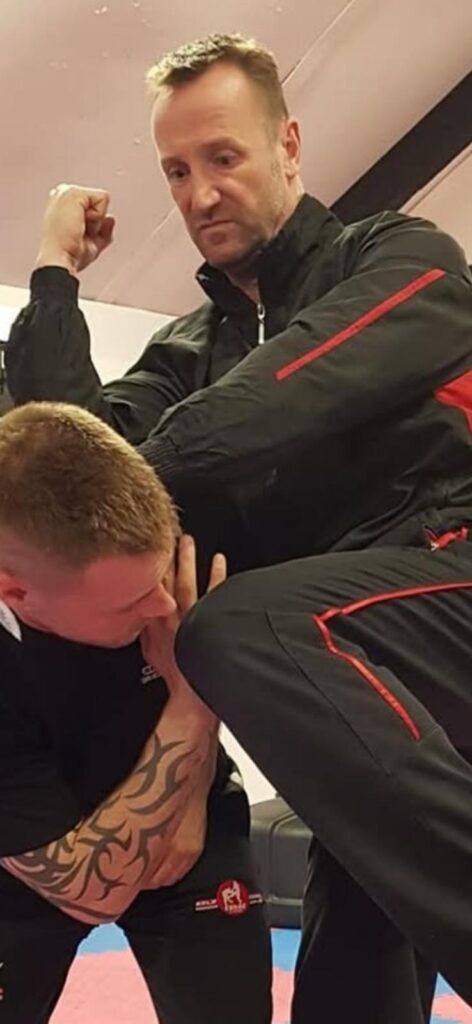
My name is Terry Garrick and I’ve been practicing and teaching martial arts and self defence for the last 40 years.

My goal is to provide people with the skills and confidence to protect themselves in their own environment or wherever they may travel in this uncertain world.

Wing Chun is often considered an effective self-defense system because it is built around practical, efficient principles rather than athleticism, strength, or flashy techniques. Here are the core reasons:

1.⁠ ⁠It’s Built for Realistic, Close-Range Encounters

Most real altercations happen at arm’s length.
Wing Chun specializes exactly in that range—trapping, intercepting, and neutralizing attacks before they develop into big strikes or grappling exchanges.
 

2.⁠ ⁠Economy of Motion (No Wasted Movement)

Wing Chun techniques travel along the shortest path: straight lines.
This means:
•Faster strikes
•Less telegraphing
•More efficient defense
 
It’s designed to end a confrontation quickly, not win a prolonged fight.
 

3.⁠ ⁠Simultaneous Attack and Defense

A key concept is to defend and attack at the same time.
Instead of blocking first and then countering, Wing Chun practitioners blend both actions, creating:
•Continuous pressure
•Faster responses
•Overwhelming counterattacks
 

4.⁠ ⁠Centerline Theory

In Wing Chun the arms are placed in front of the body with the intention of protecting the vital organs. 
The arms are placed in such a manner that they create a 3 dimensional protection shield against any incoming attack.
 

5.⁠ ⁠Reflex Training (Chi Sau)

Chi Sau conditions reflexes to react automatically to pressure, movement, and openings.
This gives practitioners an advantage in:
•Chaos
•Close range
•Surprise situations
 
It replaces “thinking about what to do” with “reacting instantly.”
 

6.⁠ ⁠Efficient for Smaller or Weaker People

Wing Chun emphasizes:
•Structure over strength
•Angles over power
•Relaxation over tension
 
This allows a physically smaller person to defend effectively against a larger attacker using leverage, timing, and positioning.
 

7.⁠ ⁠Simple, Direct and Practical 

 
No high kicks, big spinning moves, or overly complex forms.
Techniques are designed to be:
•Quick to learn
•Quick to apply
•Easy to retain under stress
 

8.⁠ ⁠Emphasis on Practical Targets

Striking focuses on:
•Throat
•Eyes
•Groin
•Knees
•Nose
 
These are high-value targets appropriate for self-defense—not sport fighting.
 

9.⁠ ⁠Continuous Attack Pressure

Wing Chun strategy is to take the initiative and keep striking until the threat is neutralized.
Pressure can overwhelm untrained attackers quickly.
 

10.⁠ ⁠Adaptability

Wing Chun has a “concept-based” approach rather than fixed techniques.
Once you understand timing, angles, and pressure, you can adapt to any situation.
 

Is Wing Chun perfect?

No system is. Effectiveness depends on training realistically and under pressure.

Developing a strong mindset, confident body language and being aware of your surroundings are important self defence attributes.

Please contact me for more info or to book into a class.

Email: tgarrick67@gmail.com

IG: terrygarrickpt

Mobile: 07838 138 011

Leave a Reply

Your email address will not be published. Required fields are marked *